
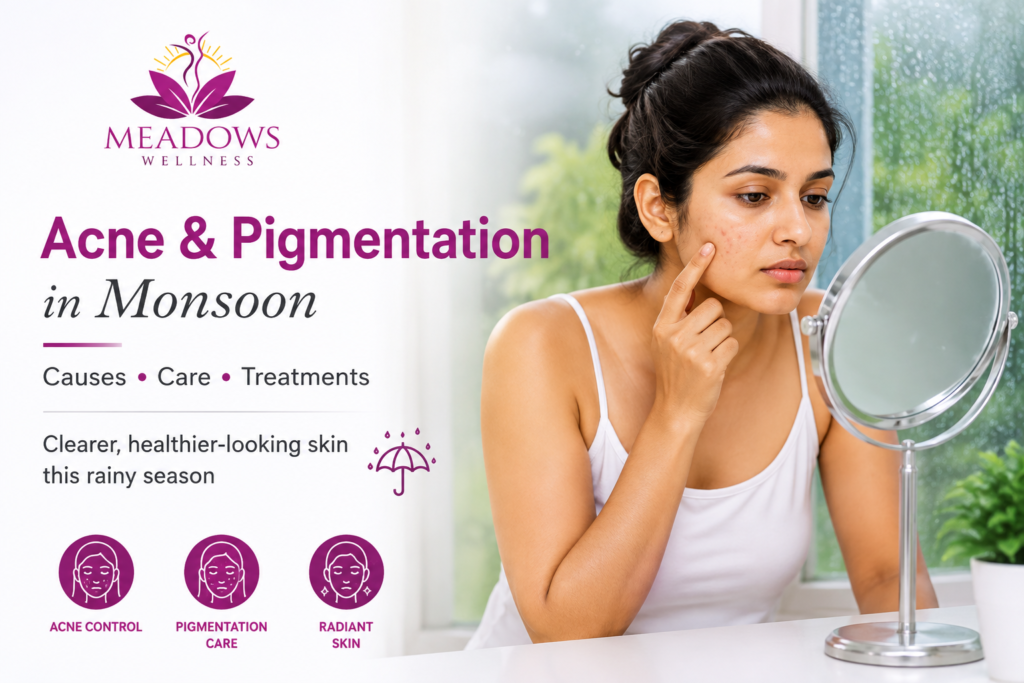
Monsoon brings welcome relief from the summer heat, but the combination of high humidity, sweat, excess oil, pollution, and changing temperatures can create a challenging environment for your skin.
For many people, the rainy season means more frequent breakouts, oily or sticky skin, clogged pores, dullness, and dark marks left behind after acne.
If you notice that your skin becomes more unpredictable as soon as the humidity rises, you are certainly not alone.
Acne and pigmentation in monsoon are common skin concerns, particularly when excess sweat, sebum, environmental pollutants, and an unsuitable skincare routine come together.
The good news is that understanding what is triggering your skin—and treating acne and pigmentation appropriately—can help you maintain clearer, healthier-looking skin throughout the rainy season.
In this guide, we explain why acne and pigmentation may become troublesome during monsoon, what you can do at home, what you should avoid, and when professional skin treatments may help.
In This Guide
- Why acne may increase during monsoon
- Why dark spots and pigmentation can appear after acne
- Common monsoon skincare mistakes
- Daily skincare tips for acne-prone skin
- How to prevent acne marks from becoming darker
- Professional acne and pigmentation treatment options
- When you should consult a skin professional
- Frequently asked questions about monsoon skin problems
Why Does Acne Increase During Monsoon?
It is easy to assume that rain automatically means cooler weather and therefore less oily skin.
In reality, monsoon weather can be extremely humid.
High humidity can increase sweating and create a moist environment on the surface of your skin. When sweat combines with sebum, dead skin cells, makeup, sunscreen, and environmental impurities, pores may become congested more easily.
This can contribute to blackheads, whiteheads, and inflammatory acne in people who are already prone to breakouts.
1. Increased Humidity and Sweating
Humidity can make sweat evaporate less efficiently, leaving the skin feeling sticky for longer periods.
Constantly wiping or touching sweaty skin can also create additional friction and irritation.
2. Excess Oil and Congested Pores
People with naturally oily or combination skin may notice that their face feels particularly greasy during humid weather.
Sweat, oil, dead skin cells, and cosmetic products can accumulate and contribute to clogged pores.
3. Pollution and Environmental Exposure
Monsoon does not eliminate pollution.
Dirt, dust, pollutants, sweat, and moisture can remain on the skin throughout the day. Proper cleansing becomes particularly important during this season.
4. Using Heavy Skincare Products
A moisturiser that felt comfortable during dry weather may feel too heavy during humid conditions.
Very rich creams and unsuitable cosmetic products may contribute to congestion in acne-prone skin.
Why Can Pigmentation Look Worse After Monsoon Breakouts?
The acne itself may disappear, but sometimes it leaves behind a darker mark.
This is known as post-inflammatory hyperpigmentation (PIH).
Inflammation caused by acne can stimulate excess pigment production in the affected area. This is why repeatedly picking or squeezing pimples can increase the likelihood of visible marks afterwards.
Sun exposure can also make existing pigmentation appear darker.
Cloudy skies do not mean ultraviolet radiation has disappeared, which is why appropriate sun protection remains important during monsoon.
Persistent or widespread pigmentation can have several causes, so professional evaluation is important when the condition does not improve.
You can explore Meadows Wellness options for Skin Brightening & Pigmentation Treatments to understand the different professional procedures available.
Monsoon Skincare Routine for Acne-Prone Skin
Your skincare routine does not need to contain ten different products to be effective.
During monsoon, consistency and choosing products appropriate for your skin type are generally more useful than constantly experimenting with new products.
Step 1: Cleanse Gently
Cleanse your face regularly with a gentle cleanser suitable for your skin type to remove accumulated sweat, excess oil, sunscreen, makeup, and environmental impurities.
Avoid aggressively scrubbing the skin because irritation can make inflamed acne feel worse.
Step 2: Keep Hydration Lightweight
Oily skin can still require hydration.
Instead of automatically skipping moisturiser, choose a lightweight, non-comedogenic product appropriate for your skin type.
Step 3: Don’t Skip Sunscreen
One of the biggest monsoon skincare myths is that sunscreen is unnecessary when the sky is cloudy.
UV exposure can still occur on cloudy and rainy days.
Daily broad-spectrum sun protection is particularly important if you already have acne marks or pigmentation.
Step 4: Avoid Touching Your Face Repeatedly
Sweat may make you want to wipe your face frequently.
Use a clean, soft tissue or towel and gently pat the skin rather than rubbing it aggressively.
Step 5: Remove Makeup Properly
Never sleep with makeup on.
During humid weather, makeup mixed with sweat and oil may contribute to congestion, particularly in acne-prone skin.
5 Monsoon Skincare Mistakes That Can Make Acne Worse
1. Washing Your Face Too Frequently
Oily skin may tempt you to wash your face every few hours.
Over-cleansing, however, can irritate the skin barrier. Use a sensible cleansing routine appropriate for your skin rather than trying to remove every trace of natural oil.
2. Scrubbing Active Acne
Physical scrubs do not “scrub away” acne.
Aggressive exfoliation can irritate already inflamed skin and may increase redness or discomfort.
3. Squeezing Pimples
This is one of the most important habits to avoid.
Picking and squeezing acne can increase inflammation and may increase the chance of post-acne marks or scarring.
4. Trying Too Many Active Ingredients Together
Using multiple acids, scrubs, retinoids, spot treatments, and other active ingredients without guidance can irritate your skin.
More products do not necessarily mean faster results.
5. Ignoring Persistent Acne
Occasional breakouts and persistent inflammatory acne are not the same thing.
If acne is painful, recurrent, leaving scars, or not responding to your routine, professional assessment is preferable to repeatedly experimenting with home remedies.
How to Prevent Acne Marks and Pigmentation
Preventing pigmentation often begins with managing the inflammation that causes it.
Don’t Pick Active Acne
Allow pimples to heal rather than squeezing them.
Use Appropriate Sun Protection
Protecting the skin from UV exposure can help prevent existing pigmentation from appearing darker.
Treat Acne Early
Repeated inflammatory breakouts increase the opportunity for post-inflammatory marks to develop.
If acne is frequent or severe, seek professional advice instead of waiting for scars and pigmentation to become established.
Be Patient With Pigmentation
Pigmentation does not usually disappear overnight.
A professional can help determine whether you are dealing with post-acne pigmentation, melasma, sun-related pigmentation, or another concern before recommending treatment.
Professional Treatments for Acne & Pigmentation at Meadows Wellness
Home skincare can be valuable, but persistent acne, acne marks, uneven skin tone, or pigmentation may benefit from professional evaluation and targeted procedures.
Meadows Wellness provides professional Skin Treatments for concerns including acne, scars, pigmentation, uneven-looking skin, and dullness. The appropriate treatment depends on your skin type, concern, severity, and professional assessment.
1. Chemical Peels
Chemical Peels use carefully selected exfoliating agents at controlled concentrations.
Different types of peels may be considered for concerns including acne, oily skin, blemishes, superficial pigmentation, uneven-looking skin tone, and texture.
The type and strength of peel should be selected according to the individual’s skin rather than attempting professional-strength peeling treatments at home.
2. Q-Switch Laser for Pigmentation
Meadows Wellness also offers Q-Switch Laser as one of its professional options for selected pigmentation concerns.
Laser treatment is not appropriate for every type of pigmentation. A professional assessment is therefore important before determining whether Q-Switch or another treatment is suitable.
3. Medi Facial
A professional Medi Facial with Lactic is another option available at Meadows Wellness for skin brightening, hydration, and improving the appearance of dull or uneven-looking skin.
The ideal facial or peel depends on the person’s skin condition and sensitivity.
4. Professional Skin Treatments
Acne, pigmentation, open pores, acne marks, and uneven skin texture often overlap.
Instead of selecting treatments individually, a professional skin consultation can help create a more targeted approach.
Explore the complete Meadows Wellness Skin Treatment range to understand the available options.
Acne Marks vs Acne Scars: They Are Not the Same
Many people use the words “acne marks” and “acne scars” interchangeably, but they can represent different concerns.
A flat brown, red, or darker area remaining after a pimple may represent post-inflammatory colour change.
A true acne scar involves a change in skin texture, such as a depression or raised area.
The treatment approach can therefore be different.
If you are unsure whether you have pigmentation, post-acne marks, or acne scars, a professional skin assessment can help identify the concern before treatment begins.
When Should You Seek Professional Help?
Consider consulting a qualified skin professional if:
- Your acne is persistent or repeatedly returning.
- You develop painful or deep inflammatory breakouts.
- Your acne is leaving visible marks or scars.
- Pigmentation continues to become darker.
- You are unsure which skincare products are appropriate.
- Over-the-counter skincare is not improving your concern.
- You have suddenly developed significant acne or pigmentation.
Early assessment may help prevent months of trial-and-error skincare and inappropriate treatments.
Why Choose Meadows Wellness for Acne & Pigmentation Care?
Acne and pigmentation do not have one universal solution.
At Meadows Wellness, skin treatments include options for concerns such as acne, scars, pigmentation, dullness, texture, and skin rejuvenation. Treatment selection can be based on individual concerns and professional assessment.
Rather than focusing only on temporarily covering the problem, the objective is to understand the concern and select an appropriate treatment approach.
Don’t Let Monsoon Take Away Your Skin’s Glow
Persistent breakouts, acne marks, or pigmentation?
Let the Meadows Wellness team help you understand your skin and explore an appropriate treatment plan.
Explore Skin Treatments | Explore Pigmentation Treatments | Book a Consultation
Frequently Asked Questions About Acne & Pigmentation in Monsoon
1. Why do I get more acne during monsoon?
High humidity, increased sweating, excess oil, friction, and accumulation of impurities can contribute to clogged pores and breakouts, particularly in people who already have acne-prone skin.
2. Does monsoon cause pigmentation?
Monsoon itself is not necessarily the direct cause of pigmentation. However, increased breakouts can leave post-inflammatory dark marks, while UV exposure can contribute to existing pigmentation becoming more noticeable.
3. Should I use sunscreen during monsoon?
Yes. UV exposure still occurs during cloudy weather. Appropriate broad-spectrum sunscreen remains an important part of a daytime skincare routine, especially for people concerned about pigmentation.
4. Can I get a chemical peel during monsoon?
Professional chemical peels may be considered at different times of the year depending on your skin, the type of peel, and your clinician’s recommendation. Suitability and aftercare should be discussed before treatment.
5. Which treatment is best for acne pigmentation?
There is no single treatment that is best for everyone. Treatment depends on whether the concern is active acne, post-inflammatory pigmentation, melasma, acne scarring, or another condition. Options may include professional skincare, chemical peels, laser procedures, or combination approaches following assessment.
6. Does Q-Switch Laser help pigmentation?
Q-Switch laser may be considered for selected pigmentation concerns. However, pigmentation has different causes and laser is not appropriate for every person or every type of pigmentation. Professional assessment is essential.
7. How can I stop pimples from leaving dark marks?
Avoid squeezing or picking acne, use appropriate sun protection, and address persistent inflammatory acne early. If marks continue to develop, seek professional advice.
8. When should I visit a skin clinic for acne?
Consider professional consultation if acne is persistent, painful, recurrent, causing scars or pigmentation, or is not responding to an appropriate skincare routine.
Clearer Skin This Monsoon Starts With the Right Care
Monsoon humidity does not mean you have to accept months of breakouts and pigmentation.
A simple skincare routine, gentle cleansing, appropriate hydration, regular sun protection, avoiding pimple picking, and timely professional advice can make a significant difference.
Most importantly, avoid treating every breakout or dark spot in exactly the same way.
Healthy-looking skin begins with understanding what your skin actually needs.
If acne, acne marks, pigmentation, or uneven-looking skin are affecting you this monsoon, explore professional skin treatments at Meadows Wellness and speak with the team about an appropriate treatment plan.
Disclaimer: This article is intended for general informational purposes and does not replace medical advice. Acne, pigmentation, and other skin conditions can have different causes. Treatment suitability, number of sessions, response, and results vary between individuals. Consult an appropriately qualified professional for assessment and personalised treatment recommendations.
“`